12.2 About the Resource Editor
12.2.1 Using the Resource Editor
Creating Resources
-
Open the Create Resource Wizard in one of these ways:
-
From the Provisioning view, open , right-click , then select .
-
Select .
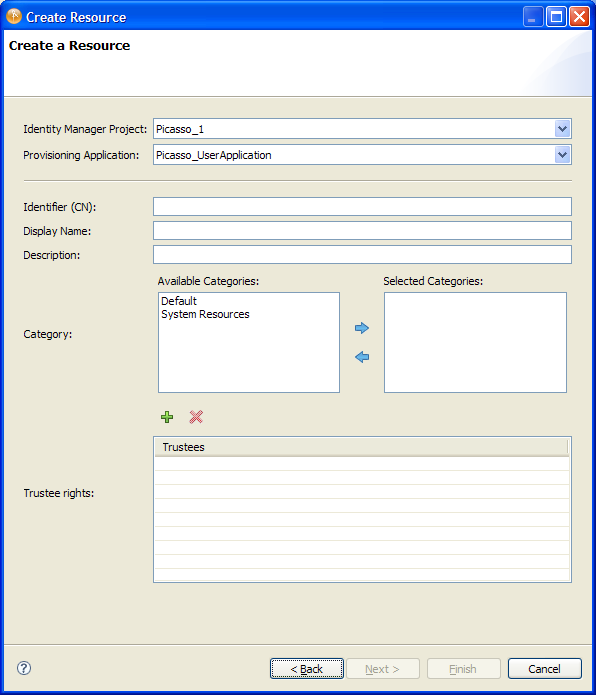
The Create Resource Wizard displays:
-
-
Fill in the fields as follows (*indicates a required field).
Field
Description
*
The name of the Designer project and the provisioning application where you want to create the resources.
NOTE:These two fields display when you launch the wizard from the menu.
*
The unique identifier for the resource.
*
The text displayed as the field in the User Application. You can translate this text into any of the languages supported by the User Application. For more information, see Section 2.10, Localizing Provisioning Objects
The text displayed as the in the User Application. You can translate this text into any of the languages supported by the User Application. For more information, see Section 2.10, Localizing Provisioning Objects.
*
Allows you to categorize resources. Used for filtering resource lists in the User Application. The category names are defined in the directory abstraction layer Resource Category list.
Specifies the users, groups, or containers that can read, compare, and browse the resources. (Read, compare, and browse are the default privileges.)
-
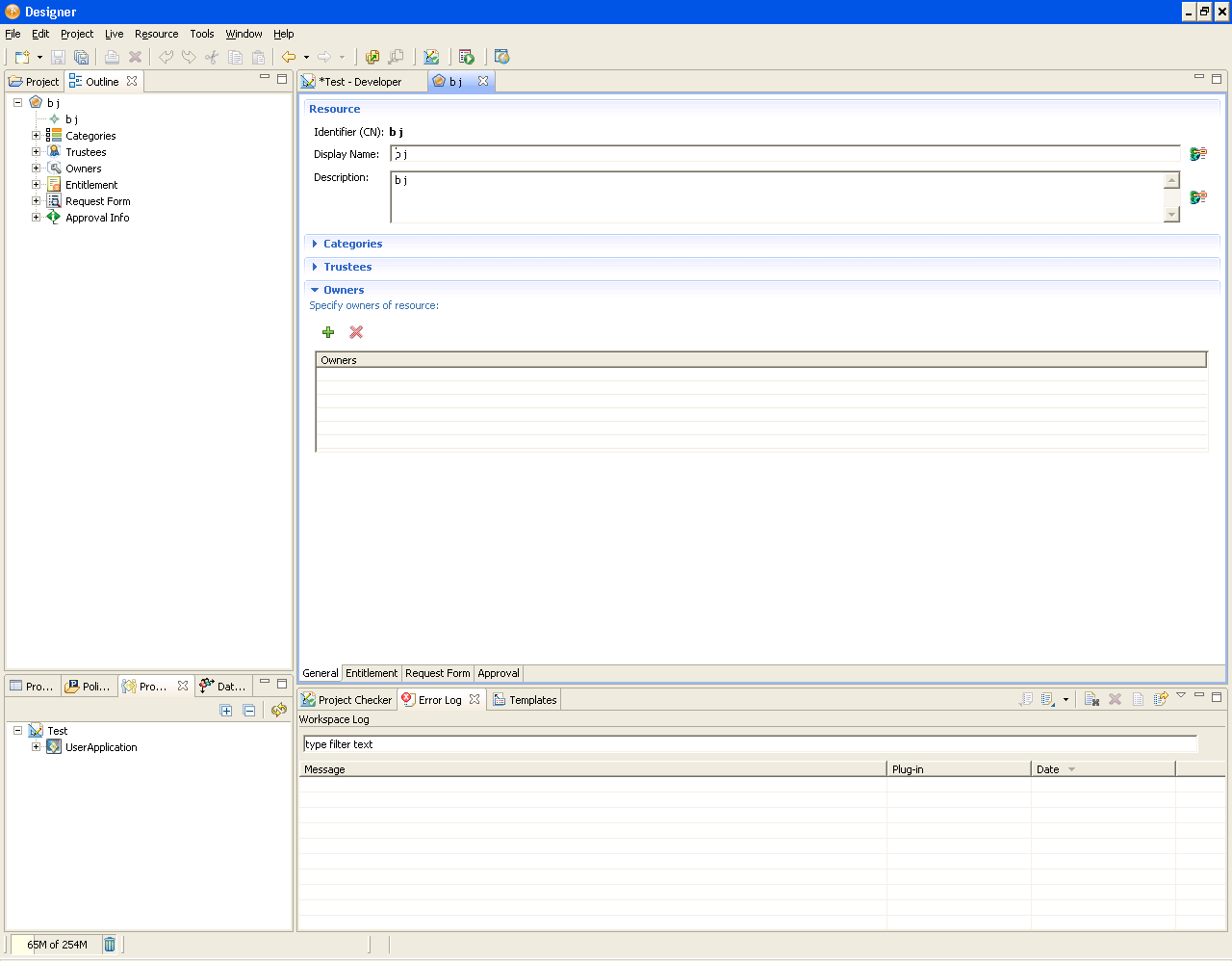
Click . Designer creates the resource locally and opens the Resource editor.
Use the tab to modify the values you entered in the wizard, and to specify a Resource Owner. For more information on the properties, see Table 12-2.
Specifying Entitlements
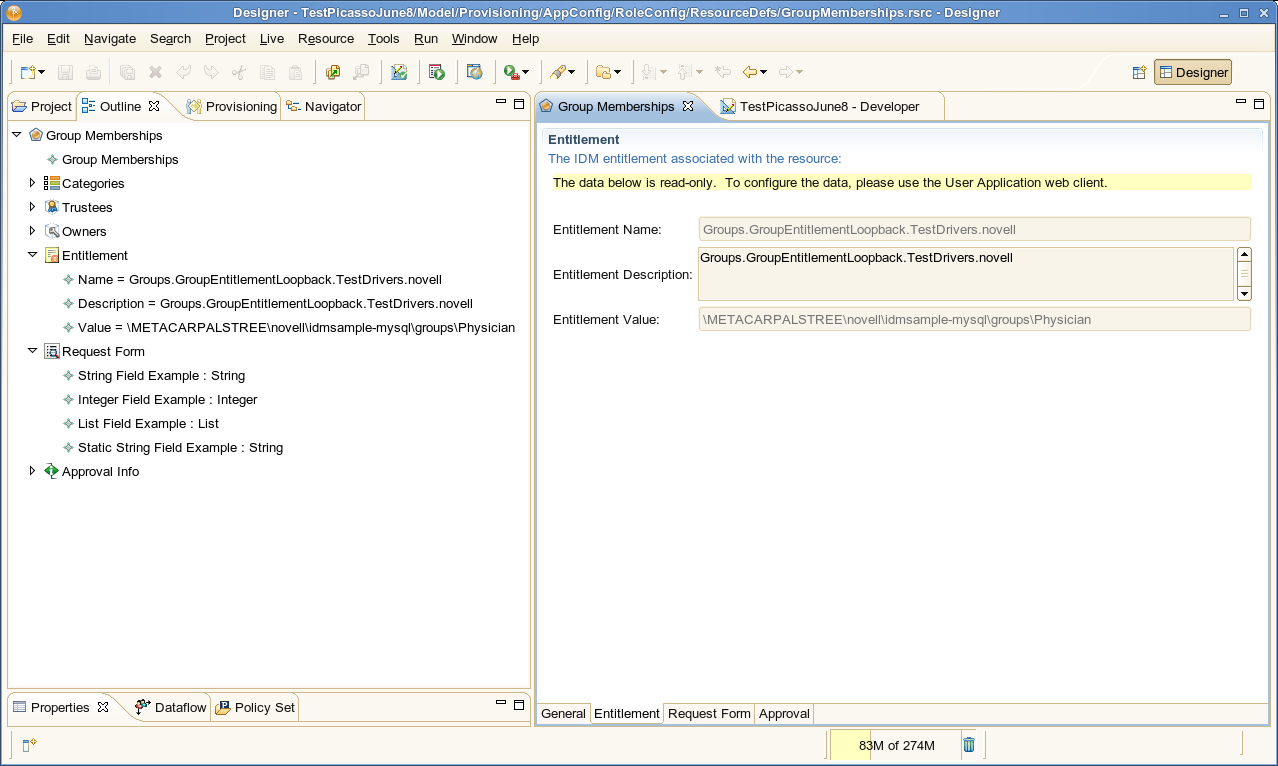
Navigate to the tab. The Entitlement page is in read-only mode. It shows entitlements associated with a resource.
|
Field |
Description |
|---|---|
|
|
The description of the entitlement if the entitlement has been imported and is known to the Designer Identity Vault. Otherwise, it is simply the entitlement DN. |
|
|
Information about the entitlement description. It could also be the entitlement DN. |
|
|
The entitlement value can be static or dynamic.
|
Specifying Request Form
Navigate to the tab. The page is in read-only mode. The information is displayed in the fields when a Resource is requested.
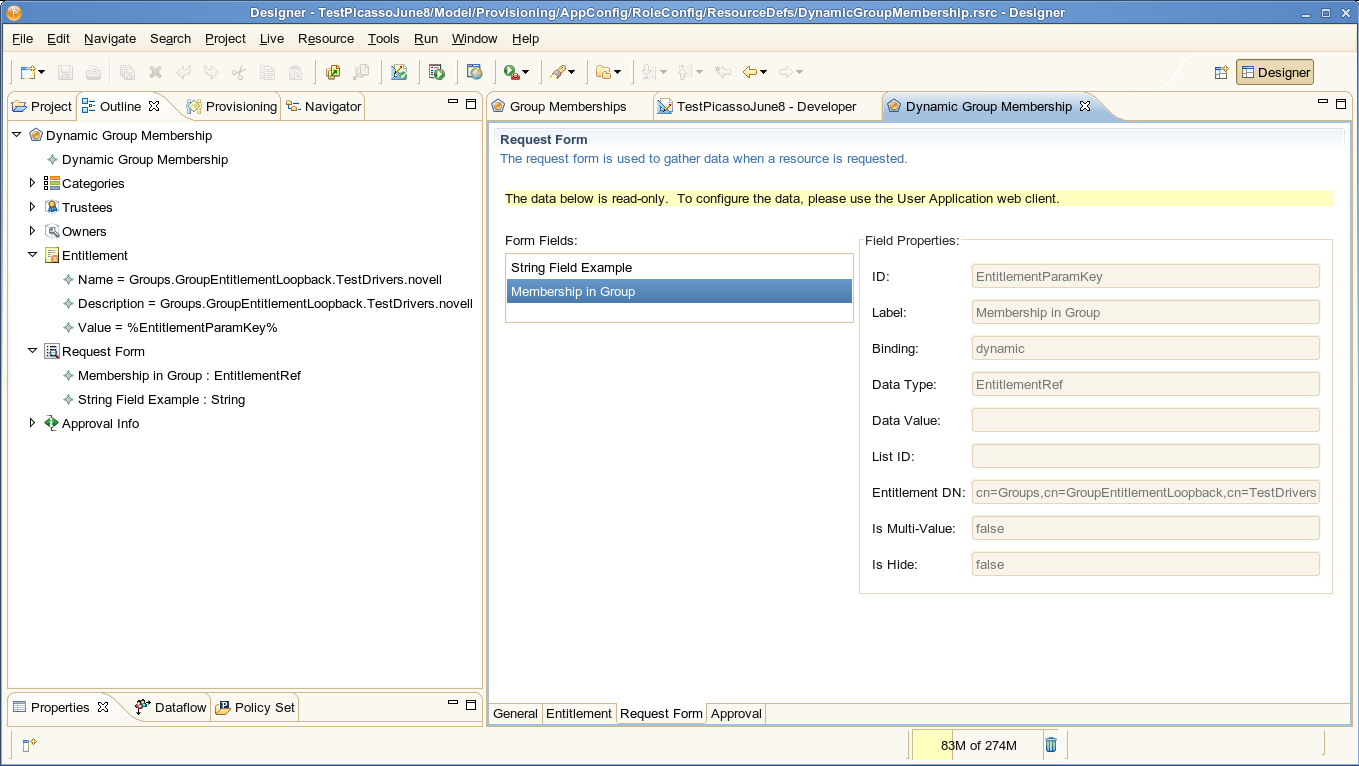
Table 12-1 Form Field Properties
|
Field |
Description |
|---|---|
|
|
The system-generated ID for the field. |
|
|
The display label to be used on the field. |
|
|
|
|
|
Can be a String, Integer, Boolean, List, or EntitlementRef type. |
|
|
The binding value can be static or dynamic.
|
|
|
If the is List, then a is specified. |
|
|
If the is EntitlementRef, then an is specified. |
|
|
Boolean. True, if users can specify more than one value for this field, else False. |
|
|
Boolean. True, if the value is hidden during the request time. |
Specifying Approvals
-
Navigate to the tab.
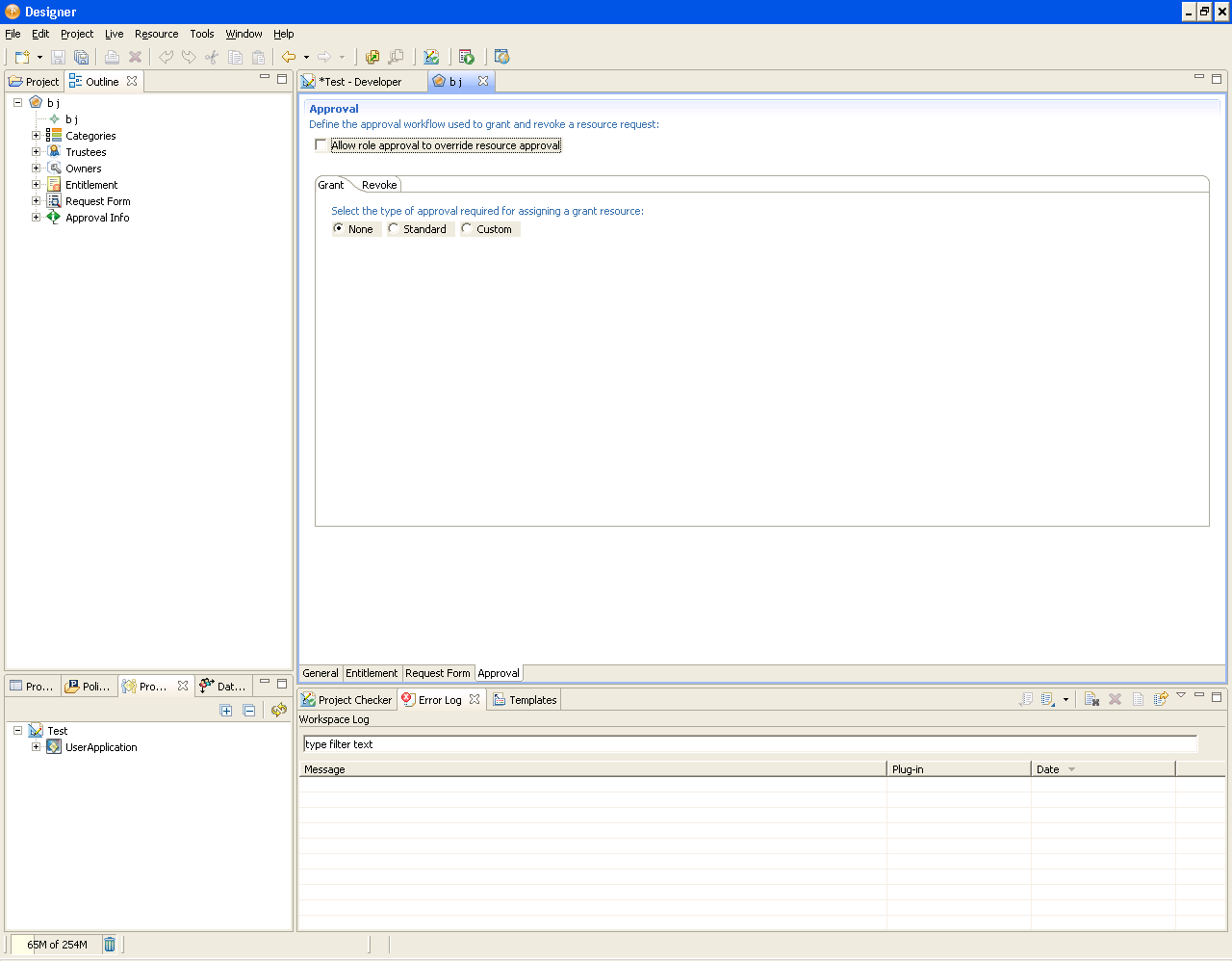
-
Select when you want the requesting system (such as role provisioning) to override approvals of the resource provisioning.
-
Click the or tab, then select the type of grant or revoke for the resource.
-
: Select this option when no approval is required for a resource grant or revoke request. Continue with Step 5.
-
: Select this option if the resource requires approval for a grant or revoke request, and you want the approval to execute the standard provisioning request definition that ships with the Roles Based Provisioning Module. Continue with Step 4.
-
: Select this option when you want to specify a custom provisioning request definition for granting or revoking resources. You are prompted to select a provisioning request definition from the dropdown list. The list is populated with approvals whose Process Type is Resource. Continue with Step 5.
-
-
For Standard Approval types, fill in the fields as follows:
Field
Description
Serial: Select this option if you want the resource grant or revoke request to be approved by the approvers listed in the Approvers list. The approvers are processed sequentially in the order they appear in the list.
Quorum: Select this option if you want the resource grant or revoke request to be approved in parallel and to be complete when the percentage of approvers specified is reached. For example, if you wanted to require that 25 percent of approvers in the list approve the condition, you would specify Quorum and specify a number; the value is assumed to be a percentage.
An approver can be a user, group, or role. To add approvers:
-
Click +.
If you are connected to the Identity Vault, the dialog box automatically displays.
-
Navigate the Identity Vault to choose your approvers.
To locate roles, navigate to the User Application driver’s AppConfig.RoleConfig.ResourceDefs container.
-
Select the approver, then click .
If Designer is not able to connect to the Identity Vault, you can add the approver manually by clicking in the row and typing the approver’s distinguished name, for example, admin.novell. Only deployed roles can be specified.
-
-
Save the Resource definition.
12.2.2 Resource Property Reference
Table 12-2 Resource Overview Properties
|
Property |
Description |
|---|---|
|
Identifier (CN) |
The unique identifier for the resource. |
|
Display Name |
The text displayed as the field in the User Application. You can translate this text into any of the languages supported by the User Application. For more information, see Section 2.10, Localizing Provisioning Objects |
|
Description |
The text displayed as the in the User Application. You can translate this text into any of the languages supported by the User Application. For more information, see Section 2.10, Localizing Provisioning Objects. |
|
Categories |
Allows you to categorize resources. Used for filtering resource lists in the User Application. The category names are defined in the directory abstraction layer Resource Category list. |
|
Trustees |
Specifies the users, groups, or containers that can read, compare, and browse the resources. (Read, compare, and browse are the default privileges.) |
|
Owners |
A user who is designated as the owner of the resource definition. The resource owner does not automatically have the authorization to administer changes to a resource definition. |